
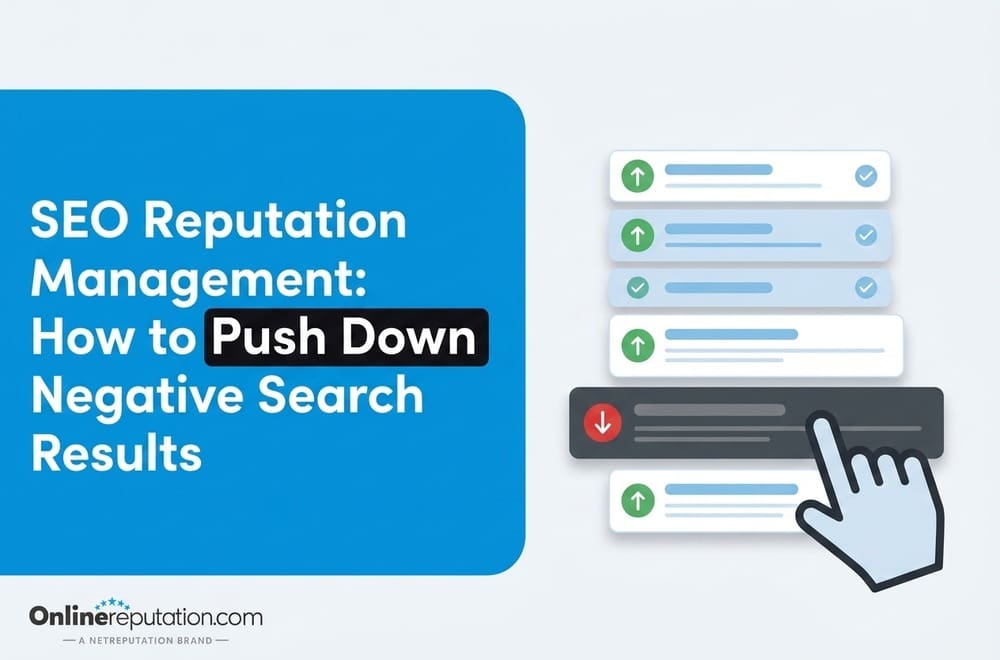
A single negative article, review, or forum thread can sit on the first page of Google for years if nothing is done about it. That’s the reality that makes SEO reputation management one of the most practical tools available to brands and individuals who want control over what people find when they search their name. Rather than trying to erase content that can’t legally be removed, SEO reputation management uses the same principles search engines use to rank any page: relevance, authority, and trust. Applied correctly, it builds up positive and neutral content until it outranks the negative, changing what people see without changing what happened.
This guide walks through how SEO reputation management works, why search visibility matters so much for brand perception, and the specific tactics that push negative content down in search engine results pages.
What Is SEO Reputation Management?
SEO reputation management is the practice of using search engine optimization techniques to shape what appears in search results for a brand, business, or individual’s name. It sits at the intersection of online reputation management and traditional SEO: instead of optimizing a single page to rank for a commercial keyword, the goal is to optimize an entire set of properties so that positive and neutral content dominates a person’s or brand’s branded search results.
The core idea is straightforward. Search engines rank pages, not entire reputations. That means a brand’s online reputation in search results is really a competition among many individual URLs — news articles, review sites, social media profiles, the company website, and sometimes negative press. Good reputation management identifies which pages are already ranking, which ones need to move up, and which ones need to be displaced.
This differs slightly from reputation management SEO, which is focused purely on damage control. SEO reputation management is both proactive and reactive. It’s used to build a strong online reputation before a crisis happens, not just to clean one up afterward.
Why Reputation Management Is Important for Search Visibility
Search results have become the first, and often only, impression a potential customer forms of a business. Consumers read reviews and search results before they read a company’s own marketing, which means online reviews and branded search results carry outsized weight in purchase decisions.
A few data points illustrate why this matters:
- 91% of consumers read reviews for local businesses before deciding whether to visit or buy.
- 91% of people trust online reviews as much as personal recommendations from friends or family.
- 91% of users never scroll past the first page of Google search results, so anything ranking on page 2 is effectively invisible.
- Positive reviews can increase click-through rates by up to 25%, meaning listings with strong ratings attract more clicks even at the same search position.
Put together, these numbers explain why a brand’s appearance in search results directly affects revenue. If negative content sits above the company website or a positive review site, potential customers search, see it, and move on to a competitor before ever engaging with the brand directly. Brands with high visibility and consistently positive reviews tend to thrive in competitive markets, while those with unmanaged negative sentiment lose customers to businesses that look more trustworthy at a glance.
Free Consultation
Talk to a Reputation Management Expert
Get a personalized plan to protect and repair your online reputation.
How Search Engines Decide What Ranks
To push down negative content, it helps to understand how search engines rank pages in the first place. Google and other search engines evaluate trust, authority, and user behavior signals to determine which pages deserve the top spots for a given query, including branded search terms.
Several factors matter most for reputation-focused SEO:
- Authority: High-quality backlinks pointing to positive digital assets — a company website, a well-regarded profile, a positive news article — signal to search engines that the content is trustworthy and worth ranking.
- Relevance: Pages that directly address the search query, including a person’s or company’s exact name, tend to outrank pages that only mention it in passing.
- Structured data: Adding schema markup helps search engines understand what a page is about, which can improve how it appears in search engine results and support AI search optimization, as AI-generated answers pull from structured, well-organized content.
- User behavior: Click-through rates, time on page, and bounce rates all feed back into search rankings over time, which is one more reason positive, engaging content outperforms thin or outdated pages.
Building strong authority for owned properties — the company website, a personal brand’s professional profiles, verified social media sites — is one of the most reliable ways to improve their position and, in turn, push weaker or negative pages further down the search engine results pages.
Google Business Profile: A Foundation for Local SEO Reputation Management
For any local business, Google Business Profile is one of the highest-leverage assets in an SEO reputation management strategy. A complete, regularly updated Google Business Profile listing does more than provide hours and directions — it shapes local search rankings and gives potential customers an immediate read on brand trustworthiness.
A few things make Google Business Profile so central to local SEO reputation management:
- Google has stated that reviews are a key ranking factor for local searches, so businesses with more (and more recent) reviews tend to see stronger local visibility.
- An optimized Google Business Profile listing can meaningfully increase perceived brand reputation, since it’s often the first thing a searcher sees for a “[business] near me” query or a location-specific query.
- Publishing Google posts regularly keeps the profile active, which supports both local SEO visibility and gives businesses a channel to highlight positive content, promotions, or responses to recent events.
- Google Business Profile reviews appear directly next to business listings in search results and Maps, making them among the most visible aspects of a local business’s online reputation.
For local businesses with multiple locations, local teams should keep each Google Business Profile listing accurate and consistent. Maintaining consistent business information — name, address, phone number, and category — across directories and business listings helps search engines trust the data, which supports stronger local search rankings across every location.
Reviews, Feedback, and Their Role in Reputation Management SEO
Online reviews sit at the center of reputation management SEO because they influence both search rankings and human decision-making. Review sites and platforms like Google Reviews, Yelp, and industry-specific directories often rank well on their own, so a brand’s reputation on those sites appears directly in its branded search results.
The data on review behavior is hard to ignore:
- 42% of customers never receive a response to the reviews they leave, despite review responses being one of the simplest ways to demonstrate good customer service and accountability.
- Responding to negative reviews can improve the overall customer experience and often turns a public complaint into a visible example of strong service recovery.
- Customer testimonials and feedback from satisfied customers, when displayed prominently, reinforce a brand’s credibility for anyone comparing options.
An effective review monitoring process should track review sites and social media posts for new customer feedback — both negative feedback that needs a timely response and positive reviews worth amplifying. Watch for fake reviews as well, since inaccurate or manipulated reviews can distort a brand’s online reputation and, in some cases, violate platform policies. Reporting them is part of good reputation management.
The goal isn’t to eliminate negative reviews entirely — that’s neither possible nor advisable. It’s to build a large enough base of recent, genuine positive reviews and thoughtful review responses that a handful of negative reviews doesn’t define the overall picture.
Free Consultation
Don't Let This Follow You Online
Every situation is different. Let's build a plan that fits yours — free consultation, no pressure.
Building Positive Content to Push Down Negative Search Results
The technical core of SEO reputation management is content: creating and strengthening positive content until it outranks negative content for branded keywords. Publishing useful, relevant content consistently can outrank negative links over time, especially when that content lives on reputable websites with existing authority.
Tactics that tend to work well include:
- Digital PR: SEO reputation management often utilizes digital PR to earn positive third-party mentions in news articles and press releases, which strengthens brand authority and pushes those pages up in search engine rankings.
- Owned content: Regularly publishing relevant content on a company website or personal brand blog gives search engines more positive, authoritative pages to rank for branded search terms.
- Third-party placements: Guest contributions, interviews, and mentions on reputable websites function as additional positive assets that a brand doesn’t have to host itself but still benefits from in search results.
- Social proof: Active, well-maintained social media sites and consistent social media posts add more legitimate, controllable pages to the mix of results for a brand’s name.
This layered approach — owned content, earned media, and social proof — creates a broader footprint of positive content across search engine results pages, making it much harder for any single negative result to dominate a brand’s online reputation.
Monitoring and Maintaining Online Reputation
SEO reputation management isn’t a one-time project. New reviews, articles, and social media posts appear constantly, and search rankings shift as competitors and reputation threats evolve. Continuous monitoring is what keeps a strong online reputation strong.
A solid monitoring routine typically includes:
- Setting up Google Alerts for branded keywords and close variations, including common misspellings, to catch new mentions as they’re indexed.
- Running regular audits of search results to see exactly where a brand’s business appears for its most important branded search results and how that position has changed.
- Tracking branded search rankings and overall sentiment over time, not just individual review scores, to spot negative sentiment before it becomes a larger issue.
- Having a response plan ready before a crisis hits, so a negative story or review doesn’t catch a business flat-footed.
Many reputation management platforms offer a free tool for basic search and review monitoring, which is a reasonable starting point for local businesses or individuals who aren’t ready for a full-service engagement. As search visibility becomes more important, particularly with AI search tools summarizing information from across the web, monitoring needs to extend beyond traditional Google search to include how a brand is described in AI-generated answers as well.
Local SEO Reputation Management for Multi-Location Businesses
Businesses with several locations face a more complex version of the same challenge: each location has its own local search results, local keywords, and review base to manage. A strong SEO reputation management program for multi-location brands typically assigns local teams to monitor and respond to reviews for their specific location, since customers expect timely, location-aware responses rather than generic corporate replies.
Consistency matters just as much here as at the single-location level. Accurate business listings, consistent information across directories, and location-specific content all support local SEO and help each location rank well for its own searches — without one location’s reputation issues bleeding into another’s search results.
Free Consultation
Ready to Take Control of Your Online Reputation?
Our team can help you remove, suppress, or respond to content like this. Talk to us today for a free, no-obligation consultation.
Building a Long-Term SEO Reputation Management Strategy
Good reputation management treats search visibility as an ongoing part of brand strategy, not a fire to put out once and forget. A durable seo strategy typically combines:
- Ongoing seo efforts to strengthen owned properties and improve their search rankings
- Active review monitoring and response across review platforms and Google reviews
- Regular digital PR to keep earning positive third-party coverage
- Continuous tracking of online visibility and brand perception across both traditional organic search and emerging AI search optimization
Over time, these seo efforts compound. A brand with a well-established, positive footprint in search results is naturally more resilient: a single piece of negative content has far less room to climb the rankings when it’s competing against years of accumulated positive assets, strong backlinks, and an active online presence.
Final Thoughts
SEO reputation management gives businesses and individuals a legitimate, sustainable way to shape their online reputation without resorting to takedown requests or hoping negative content simply fades away. By strengthening Google Business Profile listings, encouraging and responding to online reviews, publishing relevant content, and consistently monitoring search results, brands can build a strong online reputation that holds up in competitive markets — and helps their business stand out for the right reasons the next time a potential customer searches their name.
Free Consultation
Ready to Take Control of Your Online Reputation?
Our team can help you remove, suppress, or respond to content like this. Talk to us today for a free, no-obligation consultation.
You might also like

Why Your Hours and Photos Convert Customers Better Than Your Reviews
How long do mugshots stay online? In most cases, indefinitely. They sit on mugshot websites, people-finder sites, and public records …
