
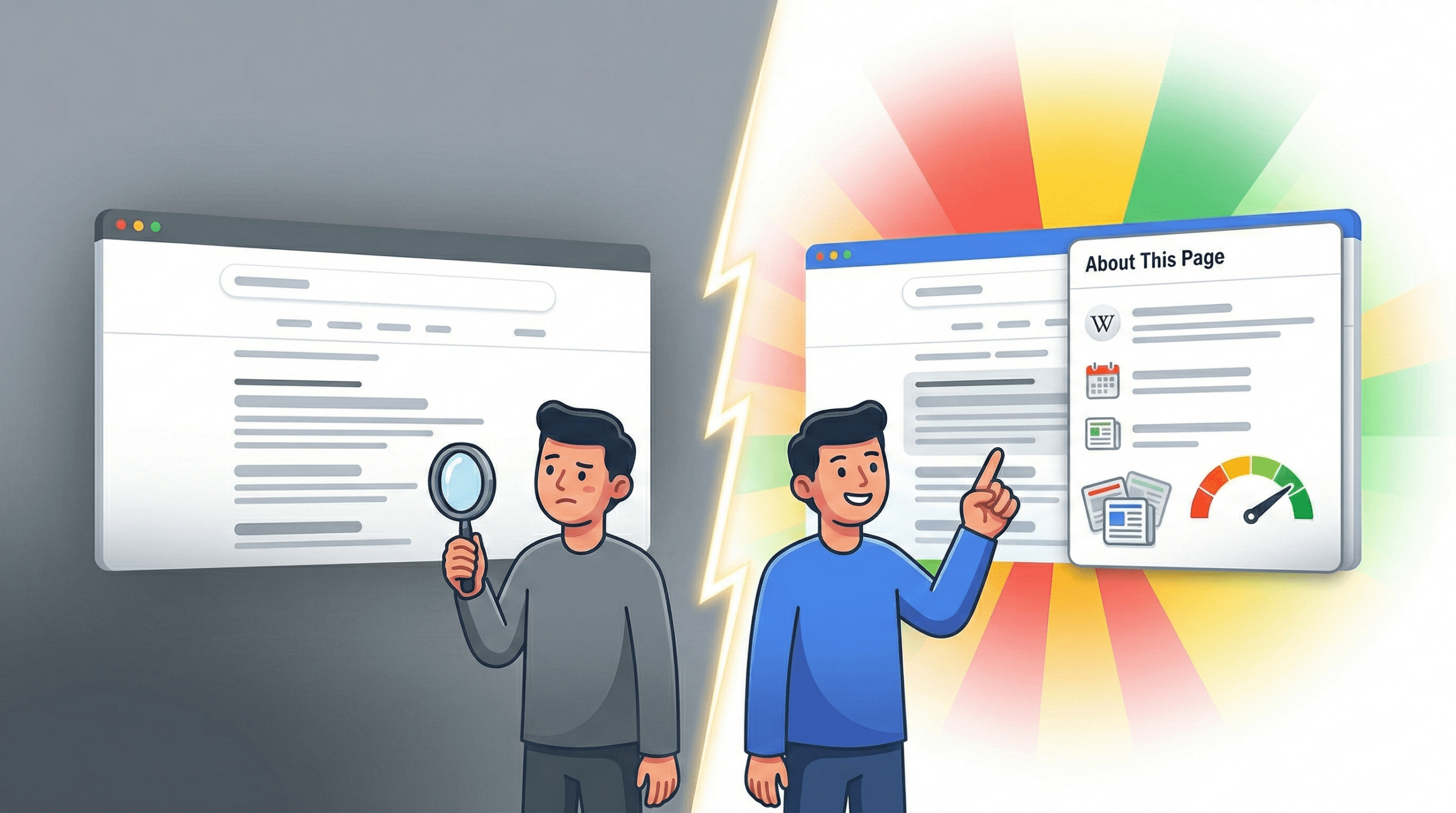
Google Search has always ranked web pages. Now it also explains them.
Google’s “About This Page” feature changes how users judge credibility before they ever visit a website. Instead of relying only on rankings, users can open a panel directly from search results and see who created the content, when it was published, and how the site is described across the open web.
This shift matters. In a world where the internet contains endless web content, users struggle to tell reliable information from inaccurate information. Google is responding by giving people more context, not just links.
The result is a quiet but important change: credibility is no longer decided after the click. It begins inside Google Search itself.
What Is Google’s “About This Page” Feature?
“About This Page” is a panel available inside Google search results. Users open it by clicking the three dots next to a result in the search bar.
The panel provides details about a web page before visiting it, including:
- A description of the website and its business or organizational address
- Information gathered from multiple sources across the web and other sites
- When the page was first indexed
- Signals that help users assess reliability, such as content expertise and page history
Its purpose is simple. Google wants users to understand where information comes from before trusting it.
Google’s ranking systems already try to identify information people are likely to find useful and reliable. But rankings alone do not explain credibility. This feature adds transparency.
Instead of asking users to blindly trust the results ranking, Google gives them tools to evaluate trustworthy information themselves.
Why Google Introduced “About This Page”
The internet makes knowledge easy to access, but difficult to evaluate.
Anyone can publish articles, videos, or other content online. That openness is powerful, but it also creates confusion. Low-quality sites and misleading pages can look similar to authoritative sources.
Google has long said it is not a truth engine. Its systems organize the world’s information and attempt to provide relevant results rather than absolute facts. Because of that limitation, users must still assess credibility.
“About This Page” helps close that gap by providing relevant content context and a high standard for transparency.
Google introduced the feature to:
- Help users understand sources quickly
- Provide a reliable information context
- Reduce reliance on ranking position alone
- Improve search literacy across the web
Digital behavior shows that many users assume top search results are automatically trustworthy. Google’s own research acknowledges this can lead to poor evaluation habits. The new panel encourages users to pause and assess using critical thinking and search operators if needed.
How Google Determines Credibility Behind the Scenes
Google’s credibility signals did not start with this feature. They come from decades of ranking systems development.
Google’s search engines work through three main steps:
- Crawling pages across the web, including services like Google Maps, to verify business addresses
- Indexing billions of webpages
- Ranking results based on relevance, quality, and user behavior patterns
Google’s ranking algorithms analyze hundreds of signals to determine relevant information. These include:
- Links from other trusted sites
- Content expertise and authoritativeness
- User intent matches the query
- Page quality signals, such as site speed and mobile friendliness (phone compatibility)
- User behavior patterns, including click-through rates and bounce rates
Google also employs more than 10,000 search quality raters worldwide. These human evaluators review search results using detailed guidelines focused on E-E-A-T:
- Experience
- Expertise
- Authoritativeness
- Trustworthiness
Their feedback does not directly rank pages, but it helps Google refine ranking systems and improve search results.
The “About This Page” panel exposes part of that evaluation process to users for the first time, helping users make sense of the full picture before clicking.
How “About This Page” Changes Google’s Credibility Model
Before this feature, credibility worked like this:
Ranking = trust signal.
If a page ranked highly, users assumed it was reliable.
Now the model looks different:
Ranking + context = credibility judgment.
Users see additional details before visiting a web page. That changes behavior in several ways.
1. Credibility Moves Before the Click
Users no longer need to open multiple pages to understand a source. The panel shows background information instantly.
This reduces blind trust in search rankings and helps users make better-informed decisions.
2. Google Shares Responsibility With Users
Google provides tools, but users must still think critically.
The feature encourages people to check:
- Who created the content written
- Whether other pages reference the site
- If information appears across multiple sources
Google helps organize information, but users determine its credibility using their own judgment.
3. Smaller Signals Become Visible
Previously hidden quality signals now directly influence perception.
Examples include:
- Site reputation across the web
- Publisher identity
- Content history and update frequency
These signals were always part of ranking systems. Now users can see them and make their own assessments.
How Users Benefit From the Feature
For everyday search behavior, the impact is practical.
Users gain faster ways to verify information without leaving Google Search.
Helpful uses include:
- Checking whether news stories come from authoritative publishers
- Evaluating unfamiliar websites before visiting
- Identifying low-quality or misleading pages
- Understanding context before sharing links on social media or phone messages
Google also supports credibility evaluation through related tools:
- Fact Check Explorer for independent fact checks
- Reverse image search to verify images and their origin
- Google News policies that prioritize authoritative reporting and highly cited stories
Together, these tools help users build a fuller picture of online information and reduce the spread of misinformation.
Why Credibility Still Isn’t Perfect
Despite improvements, Google’s credibility systems have limits.
Google’s algorithms prioritize relevance and authority, not absolute truth. Search results can still reflect bias present across the internet.
Challenges include:
- Popular content is gaining visibility even if incomplete or biased
- Filter bubble effects based on search terms and user behavior
- Society-wide biases influencing indexed data and ranking algorithms
- Users trusting rankings without critical evaluation or the use of search operators
Google openly acknowledges these limits. That is why it encourages users to verify sources independently and use tools like notices that alert when information is limited or evolving.
The “About This Page” feature helps, but it does not replace judgment.
Impact on Website Owners and Publishers
For website owners, credibility is no longer just about SEO performance or ranking high in search results.
It is about transparency and trustworthiness.
Sites that perform well under this system typically show:
- Clear authorship information and organizational identity
- Demonstrated expertise with fact-supported articles
- Consistent publishing history and updated content
- Reliable external references and high-quality incoming links
Google gives more weight to content aligned with strong expertise and trustworthiness, especially for topics affecting health, finance, or safety.
Publishers should focus on:
- Accurate about pages with clear business address and contact details
- Clear organizational identity and transparency about content creation
- Updated, helpful information created primarily for users, not just to attract money or ads
The goal is simple: make credibility easy to understand and verify.
How This Fits Into Google’s Larger Search Strategy
Google Search is built to deliver reliable, helpful, high-quality information at scale.
Sorting through hundreds of billions of webpages requires automation. But automation alone cannot explain trust.
Features like “About This Page” signal a broader shift:
Google is moving from ranking information to explaining information.
Other search engines are experimenting with similar transparency tools, but Google’s scale makes this change especially influential worldwide.
As artificial intelligence expands search capabilities, context will likely matter as much as ranking position.
Google’s services, such as Google Maps and Google News, complement Search by providing verified location and news information, enhancing overall credibility.
The Future of Credibility in Search
Search engines are evolving from answer providers into evaluation platforms.
Future credibility tools will likely:
- Compare multiple sources automatically
- Highlight fact checks more clearly
- Provide deeper publisher transparency, including business details
- Help users understand how results ranking works, including the role of ads and query intent
Google continues testing ways to improve search while maintaining open access to the web.
The direction is clear: credibility will increasingly depend on clarity, not just visibility.
Final Thoughts
Google’s “About This Page” changes credibility because it changes timing.
Trust no longer begins after visiting a website. It begins in search results.
Google still organizes the world’s information using ranking systems designed to surface helpful and reliable content. But now users receive tools to question, verify, and understand sources themselves.
That shift matters.
In an internet filled with endless information, credibility is no longer assumed. It is explained.
And increasingly, it is evaluated before the click ever happens.
You might also like

Why Individuals Are Indexed Like Products, Not People
Google Search has always ranked web pages. Now it also explains them. Google’s “About This Page” feature changes how users …
