
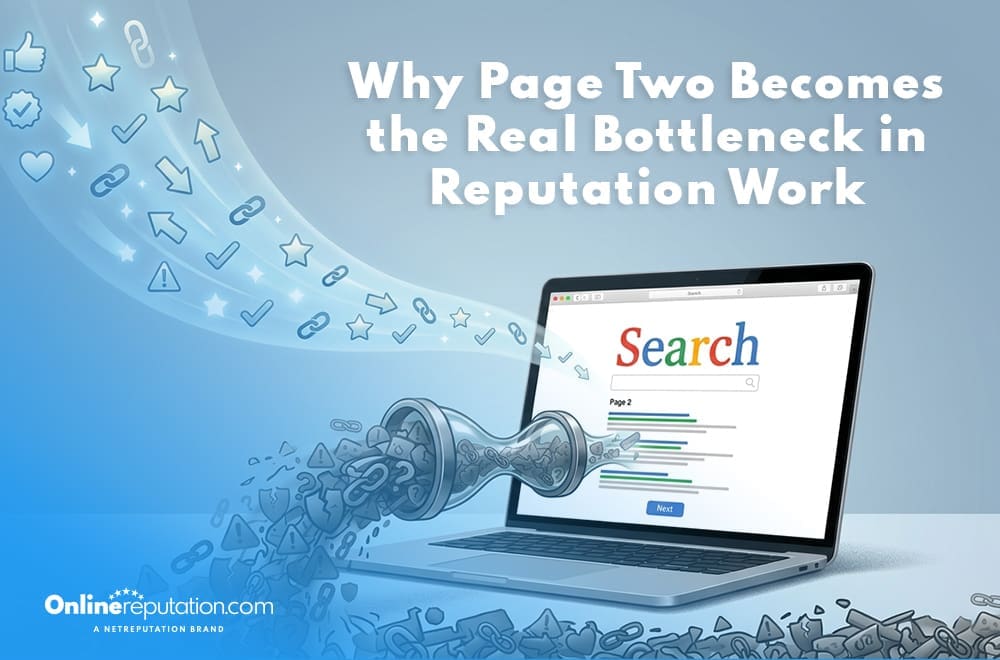
Most reputation strategies focus on reaching the first page of Google search results. That makes sense. Roughly 92% of search traffic goes to page one, and almost no users intentionally click to the second page. In fact, there’s a popular saying in the SEO world: the best place to hide a dead body is on page two of Google search results, underscoring how often this page is overlooked.
But reputation work rarely ends once positive content reaches the top results.
The real challenge begins when content stalls between positions 11 and 20 — what we call page two search results.
At that point, Google already considers the content relevant. Yet it still lacks enough authority, trust signals, and engagement to move higher. That gap turns page two into the true bottleneck in reputation work.
What Page Two Search Results Actually Mean
Page two in Google search results typically starts around position 11. Ranking there sends a clear signal:
- The page matches the search query
- The content is relevant
- But the site lacks sufficient authority compared to competitors
In simple terms, Google sees your page as useful but not the best answer yet.
Google’s ranking systems sort through hundreds of billions of webpages using many factors, including:
- keyword relevance
- backlinks and links between sites
- usability and page speed
- search history signals
- interaction data from users
- mobile performance
- content quality and structure
As a result, page two is not a failure. It is an unfinished authority.
Why Page Two Is a Reputation Bottleneck
Reputation work depends on visibility. If content remains on the second page, it technically exists but has little influence.
Less than 1% of clicks reach page two.
If you are not ranking on the first page, you are effectively invisible to most users.
Here’s the problem:
- journalists scroll deeper
- hiring managers refine searches
- customers rephrase queries
- investigators look beyond surface results
Users often adjust their search rather than click on page two results. About 15% of users rewrite their query instead.
Negative or outdated content can remain visible during those deeper searches, quietly shaping perception.
That is why page two search results often continue to affect reputation even after strong content appears on page one.
Free Consultation
Ready to Take Control of Your Online Reputation?
Our team can help you remove, suppress, or respond to content like this. Talk to us today for a free, no-obligation consultation.
How Google Determines Which Pages Move Forward
Google search systems try to connect curiosity to knowledge as accurately as possible. To do that, algorithms evaluate:
- the words used in a query
- page relevance to the subject
- website authority
- links from other sites
- user engagement signals
- loading speed and usability
One important factor stands out: links.
When other prominent websites link to your content, Google interprets that as validation. Links act as votes of confidence.
This explains why many pages remain stuck on page two. They lack sufficient trusted backlinks to compete with higher-ranking pages.
The Authority Gap Between Page Two and Page One
Moving from page two to page one is not a small improvement. Studies show it can generate over 143% more organic traffic.
The difference usually comes down to authority signals:
- stronger internal links
- higher-quality backlinks
- better structured titles and meta descriptions
- clearer topical relevance
- improved engagement above the fold
Page two often has good content but weaker reinforcement.
Think of it this way:
Page one = trusted answers.
Page two = promising candidates.
Why More Content Alone Does Not Fix the Problem
Many businesses respond by creating more blog posts or adding more pages.
More content helps only when it adds value.
Google’s systems analyze whether content truly answers a query. Repetition without improvement rarely changes ranking.
Instead, successful reputation work focuses on strengthening existing assets.
That includes:
- editing titles and meta descriptions
- improving internal links
- updating outdated details
- adding helpful images or videos
- improving page speed
- clarifying the main subject
Quality signals matter more than volume.
Free Consultation
Talk to a Reputation Management Expert
Get a personalized plan to protect and repair your online reputation.
Backlinks: The Main Lever for Page Two Movement
Producing content that earns quality backlinks remains essential for SEO improvement.
Google uses links as a major ranking factor because they reflect trust across the web.
Effective backlink strategies include:
Broken Link Technique
Replace dead links with better content.
Steps:
- Find pages linking to outdated or dead content
- create a stronger resource
- Contact site owners and suggest your page as a replacement
Rewriting dead content often increases the success of link acquisition.
Competitor Backlink Analysis
Analyze competitors’ backlinks using SEO tools.
Look for:
- shared linking domains
- industry resources
- directories and publications
This data helps determine where your site lacks authority.
Internal Links: The Most Overlooked Reputation Tool
Internal links transfer authority across a website.
Linking from high-authority pages to page two content signals importance to Google’s system.
Strong internal linking:
- improves site navigation
- helps users find relevant resources
- increases ranking potential
- strengthens topical relevance
Many reputation bottlenecks exist simply because important pages are isolated.
Technical Factors That Keep Pages Stuck
Sometimes rankings stall due to usability issues rather than content quality.
Google evaluates:
- page load speed
- mobile friendliness
- structured data
- layout clarity
- engagement signals
Engaging the area above the fold increases dwell time and reduces bounce rates. These signals help determine whether users find the page helpful.
Schema markup can also qualify pages for rich snippets, increasing visibility within search results.
Free Consultation
Don't Let This Follow You Online
Every situation is different. Let's build a plan that fits yours — free consultation, no pressure.
How to Identify Page Two Problems
Start with data, not assumptions.
Use tools like:
- Google Search Console
- SEMrush
- Ahrefs
Identify pages ranking between positions 11–20.
Review:
- keyword alignment
- backlink profile
- internal linking
- title tags and meta descriptions
- user engagement signals
Page two ranking means improvement is possible without starting from scratch.
Practical Tips to Move From Page Two to Page One
Focus on reinforcement rather than expansion.
Improve Existing Content
- Update outdated information
- Add examples and clearer answers
- Expand helpful sections
Strengthen Titles
Keep titles under 60 characters and place the primary keyword near the front.
Add Unique Value
Create content that competitors do not offer:
- original insights
- better explanations
- clearer structure
Build Strategic Links
Acquire backlinks through outreach and resource creation.
Improve User Experience
Optimize speed, layout, and readability.
Use New Features and Tools
Stay informed about Google’s new features and updates to leverage them for better rankings.
Understanding User Behavior and Browser Interaction
Visitors using different browsers and devices may see different search results, especially if they are logged in to their Google account. This logged-in status influences personalized search history and can affect page rankings, underscoring the importance of understanding how your visitors interact with your content across platforms.
Users often provide valuable feedback through comments or social shares, which can signal engagement and increase the perceived authority of your content.
Free Consultation
Ready to Take Control of Your Online Reputation?
Our team can help you remove, suppress, or respond to content like this. Talk to us today for a free, no-obligation consultation.
Why Page Two Matters for Reputation Management
Visibility shapes perception.
When negative or outdated content remains near the top of page one, it continues to influence deeper searches, even if most users never scroll.
Reputation work succeeds when positive, relevant content becomes the dominant answer Google presents.
Page two represents the final stage before authority recognition.
That is why it becomes the real bottleneck.
Final Thoughts
Page two search results are not a failure. They are a signal.
Google already considers the content relevant. The system is waiting for stronger trust signals before promoting it.
Reputation recovery is rarely about creating endless new pages. It is about strengthening what already exists through links, relevance, usability, and authority.
Moving a page from position 12 to 8 changes visibility dramatically.
In search, progress is rarely blocked by relevance.
It is blocked by the authority.
And that is why page two becomes the real bottleneck in reputation work.
Note: Remember to monitor your Google Search Console account regularly to notice changes in rankings and user behavior.
Free Consultation
Don't Let This Follow You Online
Every situation is different. Let's build a plan that fits yours — free consultation, no pressure.
You might also like
How Phone Number Recycling Creates Reputation Confusion
Your phone number feels personal. It follows you across online accounts, text messages, password resets, and customer accounts. But in …
