
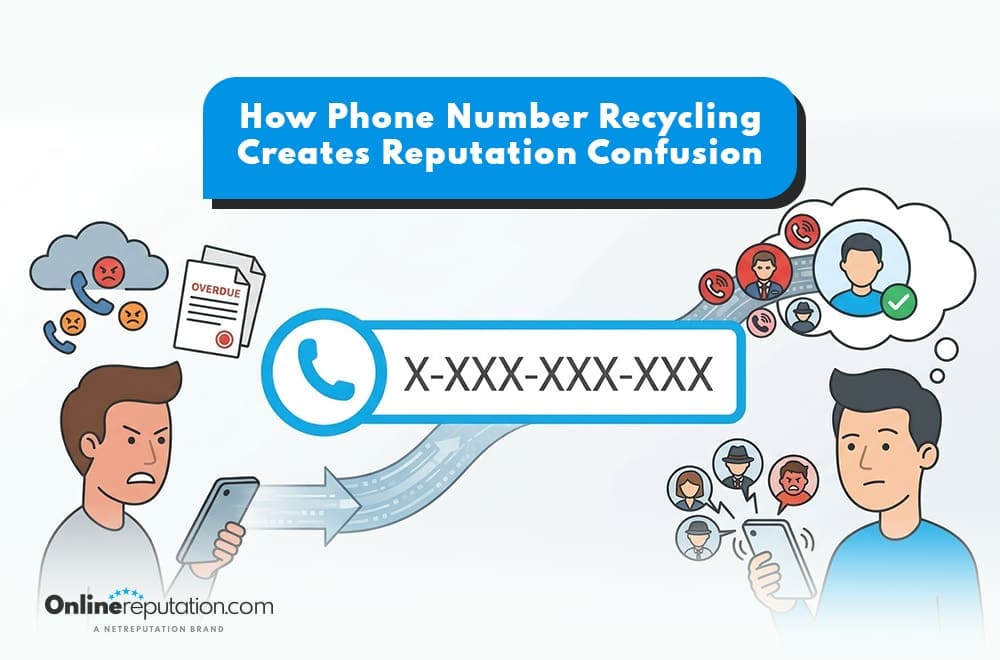
Your phone number feels personal. It follows you across online accounts, text messages, password resets, and customer accounts. But in reality, phone numbers are temporary. And that gap between how people think phone numbers work and how they actually work is where reputation confusion begins.
Phone number recycling is a standard practice. Mobile network operators reuse old phone numbers after a certain period to manage number availability and enable high-speed data services for new subscribers. Each year, roughly 35 million phone numbers are recycled in the U.S., according to the Federal Communications Commission. That means millions of people inherit phone numbers with a past they did not create.
This creates a critical vulnerability. A recycled phone number can still be tied to the previous owner’s online accounts, data breaches, and digital footprint. For new users, that history can lead to privacy risks, security risks, and even account takeover fraud.
What Is Phone Number Recycling?
Phone number recycling, also called number recycling or phone recycling, is the process of reassigning a previously used mobile phone number to a new user.
When an original user disconnects service, switches carriers, or stops paying for a mobile plan, the phone number is deactivated. It does not disappear. Instead, it enters an aging, or dormancy, period. In the U.S., the FCC requires a minimum 45-day aging period for permanently disconnected numbers. In practice, many carriers wait 30 to 90 days before reuse.
After that certain period, the number becomes part of the pool of available phone numbers and may be reassigned to a new subscriber with a new SIM card and new service.
From the carrier’s perspective, this process is necessary. There is a limited supply of available numbers. Recycling helps mobile network operators manage growth without exhausting number ranges.
From a user’s perspective, it rarely feels like a fresh start.
Why Recycled Phone Numbers Carry Risk
When a phone number is recycled, the connection between the number and the original owner is not always fully erased.
Many online services treat phone numbers as long-term identifiers. It is used for:
- Password reset links
- SMS two-factor authentication
- Account recovery
- Identity verification
- Customer contact records
If a previous owner failed to remove their number from online accounts, that connection can remain active long after the number is reassigned.
As a result, recycled phone numbers can still be linked to:
- Old social media profiles
- Financial institution logins
- Search services and people-lookup tools
- Data breaches involving personally identifiable information
This creates hidden risks for both individuals and businesses relying on phone numbers as a trusted signal.
Free Consultation
Talk to a Reputation Management Expert
Get a personalized plan to protect and repair your online reputation.
How Reputation Confusion Happens
Reputation confusion occurs when a new owner inherits a phone number that systems still associate with previous users.
A recycled phone number may already appear suspicious to fraud detection systems. It may have been flagged due to phishing attacks, social engineering attacks, or prior misuse. When that number is reassigned, those signals do not always reset.
New users often experience this immediately. They receive private messages, calls, or text messages intended for the original owner. In more serious cases, they receive password reset codes for online accounts they do not own.
From the system’s perspective, the number appears active and familiar. From the intended user’s perspective, it is a serious privacy and security issue.
How Fraudsters Exploit Recycled Numbers
Bad actors understand phone number recycling better than most users.
A fraudster can gain access to recycled numbers in several ways. They may activate a new SIM card, use prepaid plans, or monitor reassigned numbers through social engineering. Once they control a recycled phone number, they can attempt targeted takeover attacks.
Here is a common pattern:
- An attacker uses people search services to identify a previous owner tied to a phone number.
- They check whether that person appears in known data breaches.
- They attempt to reset passwords for online accounts still linked to the old phone number.
- SMS verification codes are delivered to the attacker’s phone.
- Account takeover can occur without the original password.
This is why recycled phone numbers are a significant risk for identity theft and account takeover fraud. SMS-based authentication was never designed to handle reused identifiers.
The Impact on Individuals
For new owners, reputation confusion can feel random and frustrating.
Common signs include:
- Receiving calls and text messages meant for someone else
- Being locked out of new accounts due to suspicious number checks
- Failing phone number verification during sign-up
- Exposure to private messages containing sensitive data
In the worst cases, recycled numbers allow fraudsters to commit fraud by intercepting authentication messages. The new owner did nothing wrong, but they inherited the consequences.
User education programs can help individuals understand these risks, but awareness alone does not solve the problem.
Free Consultation
Don't Let This Follow You Online
Every situation is different. Let's build a plan that fits yours — free consultation, no pressure.
The Impact on Businesses
For businesses relying on phone numbers to protect customer accounts, number recycling creates a structural problem.
Phone numbers are often treated as a stable identifier. In reality, they are not. When businesses fail to account for recycled numbers, several things happen:
- Legitimate users are blocked due to suspicious numbers
- Fraudsters bypass SMS 2FA
- Customer records become inaccurate
- Identity verification loses reliability
Financial institutions, in particular, face a significant risk. A single recycled number can undermine trust across multiple systems. This is why organizations need to build a robust strategy to defend against recycled phone number fraud.
Why Traditional Verification Falls Short
Basic phone number verification only confirms that a number can receive messages. It does not confirm:
- Whether the number was recently reassigned
- Who the current owner is
- How long has the number been active
- Whether it carries a risky history
Without real-time checks, businesses cannot distinguish between an original user and a new subscriber.
This gap allows attackers to reuse credentials during account recovery, onboarding, and password reset flows.
How to Detect Recycled Phone Numbers
The most effective defense is real-time phone verification.
Advanced phone verification APIs can detect when a number has been deactivated or reassigned. These tools analyze:
- Number, age, and tenure
- Carrier status
- Device behavior
- Usage patterns
The FCC Reassigned Numbers Database also allows companies to check whether a number has been reassigned before sending sensitive information.
AI and machine learning now play a major role. By analyzing data across millions of mobile devices, modern systems can flag suspicious numbers before damage occurs.
Free Consultation
Ready to Take Control of Your Online Reputation?
Our team can help you remove, suppress, or respond to content like this. Talk to us today for a free, no-obligation consultation.
Reducing Risk with Smarter Authentication
Organizations should not rely on mobile numbers as the only source of truth.
To mitigate risks, businesses should:
- Implement multi-layered defense strategies
- Reduce reliance on SMS-based 2FA
- Adopt app-based authenticators where possible
- Use real-time phone number verification
- Maintain accurate customer records
Using app-based authenticators instead of SMS codes significantly reduces exposure to recycled numbers. Real-time checks add an additional layer of protection during sensitive operations.
Companies must adapt their identity verification strategies to reflect how phone numbers actually behave in the real world.
Staying Ahead of Phone Number Recycling Risks
Phone number recycling is not going away. It is a regulated practice designed to keep mobile systems functioning.
The real issue is not the recycling process itself. It is the extent to which trust systems place in reused phone numbers without context.
To stay ahead:
- Businesses must proactively protect customer accounts
- Verification strategies must evolve
- User education must improve
- Real-time detection must become standard
A phone number is no longer a reliable identity anchor on its own. Treating it as one creates confusion about reputation, increases fraud risks, and causes unnecessary harm to users.
Final Takeaway
Phone number recycling creates reputation confusion because digital systems remember what carriers forget.
A recycled phone number can carry history, risk, and exposure from a previous owner into a new account. Without modern verification and smarter authentication, that history becomes a liability.
The goal is not to stop recycling numbers.
The goal is to stop blindly trusting them.
Free Consultation
Ready to Take Control of Your Online Reputation?
Our team can help you remove, suppress, or respond to content like this. Talk to us today for a free, no-obligation consultation.
You might also like
How Profile Pages Become Default Identity References
Profile pages often speak for us long before we have a chance to introduce ourselves. For example, a LinkedIn profile, …
