
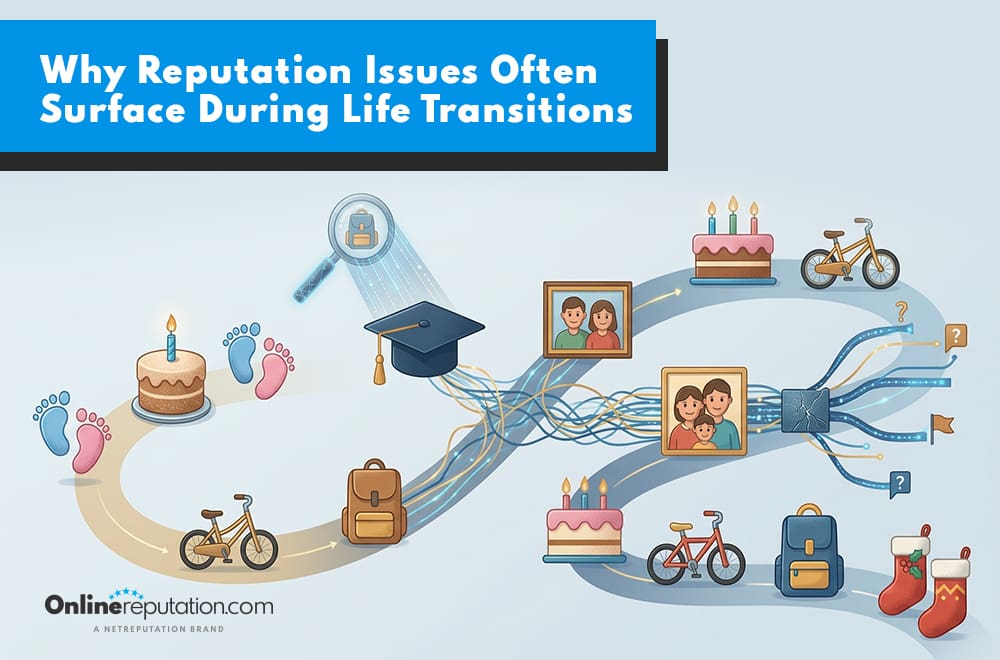
Reputation issues often surface during life transitions because transitions change expectations, increase scrutiny, and reveal underlying weaknesses. A company’s reputation may appear stable for ten years, but once restructuring, leadership shifts, operational change, or market stress begins, reputational risk becomes harder to contain.
During these moments, public perception shifts from what a company says to what it does.
And when customer trust is fragile, even a single incident can expose deeper internal issues, create reputation challenges, and trigger a broader business reputation crisis.
Reputation issues rarely begin during a transition. They are usually exposed to it.
That is why risk, crisis, and reputation management strategies are essential during periods of organizational change — especially when a significant portion of the organization is already under pressure.
Why Transitions Increase Reputational Risk
Transitions increase reputational risk because organizations are forced to operate under new conditions while older, unresolved risks remain active in the background. During these periods, executives and key stakeholders often face:
- shifting priorities
- resource strain
- fragmented communication across multiple channels
- policy and governance gaps
- disengaged employees
- delayed escalation of serious issues
And when those factors intersect, reputation risks move into public view.
Common triggers include:
- restructuring or layoffs
- rapid scaling or market expansion
- Third-party suppliers failing compliance or quality checks
- delayed system upgrades
- Poor-quality service reaching customers
- internal concerns becoming external negative press
A damaged reputation rarely comes from a single incident alone.
It becomes a serious issue when the event confirms what affected parties and customers already suspected about the company’s public image, brand reputation, or crisis response capabilities.
When affected customers feel their concerns were dismissed, public trust weakens, brand equity erodes, and the company’s image becomes harder to recover fully.
Why Internal Issues Become Public During Change
During stable periods, internal issues are often contained. Teams compensate for gaps, work around broken processes, or prevent negative experiences from reaching customers.
But during transitions, those same issues surface.
This is when reputational damage appears in key areas like:
- product defects or poor quality outcomes
- safety and duty-of-care breakdowns
- data protection failures
- culture and leadership concerns
- lack of transparent communication
- unclear ownership or accountability
Actions speak louder than messaging — and during stressful periods, actions are evaluated more closely.
Reputation crises develop faster when:
- Complaints were ignored
- Environmental responsibility and corporate responsibility appear secondary
- Leadership minimizes impact instead of addressing concerns
- Damage control replaces effective response
The result is a broken reputation narrative — where the company’s image no longer aligns with the brand image customers expect.
And once public perception shifts, reputation recovery becomes an ongoing process rather than a short-term fix.
Why Reputation Issues Surface More Often During Times of Change
Periods of transition attract scrutiny from:
- customers
- employees
- executives
- investors
- community leaders
- media outlets
- affected parties
Public trust depends on whether a company maintains credibility when tested — not just when conditions are stable.
Research across similar incidents and other organizations shows that reputation issues can:
- erode customer trust
- reduce market share
- increase financial losses
- Weaken brand equity
- Damage to financial performance
- creates long-term potential risks for future incidents
In many industries, a company’s reputation directly affects market value. Reputation issues do not just change the company’s public image — they affect whether customers stay, whether communities maintain trust, and whether companies emerge stronger after a disruption.
Transitions do not create the underlying weakness.
They reveal it.
What Typically Causes Reputation Issues to Surface
Most reputation challenges during transitions fall into predictable reputational risk categories:
- product failures or poor quality interactions
- data leaks and compromised customer information
- unethical conduct or misleading communication
- breakdowns in leadership credibility
- Third-party suppliers failing standards
- slow or defensive crisis response
- lack of genuine commitment to corrective action
A single incident often becomes a textbook example when it confirms larger systemic issues.
Negative press spreads faster when customers see:
- repeated mistakes
- unclear ownership
- inconsistent messaging
- lack of visible corrective action
Public perception changes quickly when actions do not align with stated values — especially in industries tied to safety, trust, civic impact, or environmental responsibility.
Companies that prioritize transparency and swift action are better positioned to rebuild trust and prevent similar incidents from escalating.
Companies that rely on good intentions — instead of measurable change — seldom fully recover.
Why Trust Breaks Faster Than It Recovers
Trust erodes faster during transitions because stakeholders are already uncertain. They look for reassurance that executives are aligned, that responsibilities are clear, and that customer trust remains the priority.
Trust breaks when:
- Communication feels defensive
- Accountability is vague
- Affected customers feel unheard
- Employees describe internal problems publicly
Employee-generated content often receives more engagement than official messaging — meaning internal reality shapes external reputation.
When internal culture contradicts public messaging, the company’s reputation shifts from credibility to skepticism.
And when personal data leaks or privacy failures occur, customers and affected parties lose confidence far faster than reputation recovery can compensate.
Rebuilding trust requires more than carefully written statements.
It requires accountable decisions — demonstrated through action.
Why Corrective Action Matters More Than Messaging
In periods of reputational risk, crisis response is not measured by tone — it is measured by impact.
Organizations recover more effectively when they:
- Prioritize transparency over damage control
- Acknowledge affected customers and affected parties directly
- Take visible corrective action
- demonstrate genuine commitment to long-term improvement
- Monitor outcomes to prevent future incidents
Swift action matters because public trust depends on whether leadership addresses concerns decisively.
Statements do not preserve a good reputation.
It is preserved when:
- Accountability is clear
- Recovery strategies are credible
- Companies show how they will prevent similar incidents
Reputation recovery succeeds when companies treat accountability as operational — not symbolic.
Where Reputational Risk Escalates the Fastest
Reputation issues intensify when they intersect with:
- emotionally sensitive situations
- brand promises tied to safety or ethics
- social media backlash
- delayed acknowledgment
- inconsistent response across multiple channels
Social media accelerates exposure.
A single incident can redefine a company’s public image in hours — even if pilot error, supplier failure, or internal process gaps were the original cause.
Reputational crises escalate faster when:
- affected parties feel dismissed
- negative content spreads across social media
- media outlets amplify the narrative
- statements appear controlled rather than transparent
AI-powered monitoring, answer-graph strategies, and thoughtful review ecosystems help surface accurate brand stories — but only when paired with meaningful action.
Monitoring alone is not reputation management.
Response is.
Reputation Risk and Market Value During Transitions
Reputation is inseparable from financial outcomes.
Reputational damage affects:
- revenue
- market value
- investor confidence
- recruiting and retention
- long-term customer trust
A damaged reputation reduces resilience — even after the negative press quiets down.
Organizations that fail to act with genuine commitment face deeper losses than those that prioritize transparency and act early.
Companies that acknowledge risk, address affected customers directly, and demonstrate accountability are more likely to:
- maintain trust
- Stabilize brand equity
- protect market share
- emerge stronger over time
Those that rely on messaging alone rarely fully recover — because reputation recovery is an ongoing process, not a public relations event.
What Effective Reputation Management Looks Like During Change
Reputation management is not a marketing function.
It is a risk management discipline.
During transitions, an effective response includes:
- assessing the damage objectively
- aligning executives and key stakeholders
- prioritizing transparency in communications
- addressing concerns across multiple channels
- supporting affected customers and community leaders
- deploying trust-building initiatives
- strengthening quality controls and supplier oversight
- monitoring outcomes to prevent future incidents
Strong continuity planning allows companies to move from reaction to structured, accountable action.
Long-term recovery strategies also include:
- employee engagement aligned with company values
- improved oversight of third-party suppliers
- Operational risk auditing across key areas
- proactive management of brand reputation and the company’s image
- search governance to protect the company’s public image and the brand’s image
The goal is not to avoid criticism.
The goal is to ensure that when reputation issues surface — particularly during life transitions or organizational change — the company responds with clarity, accountability, and measurable improvement.
Final Perspective
Reputation issues surface during transitions because transitions expose the truth.
They reveal:
- where systems are weak
- where culture is misaligned
- where communication lacks credibility
- where accountability has been deferred
Exposure itself is not failure.
Avoiding it is.
Reputation recovery relies on:
- transparent communication
- genuine commitment
- corrective action
- ongoing improvement
- and leadership that accepts responsibility
Companies that act with integrity and prioritize stakeholders can rebuild trust and emerge stronger — even after severe incidents.
Companies that rely on statements, good intentions, and temporary damage control do not prevent similar incidents.
They delay them until the next transition makes them visible again.
You might also like
How Reputations Are Lost In Aggregated Profiles
Reputation issues often surface during life transitions because transitions change expectations, increase scrutiny, and reveal underlying weaknesses. A company’s reputation …
