
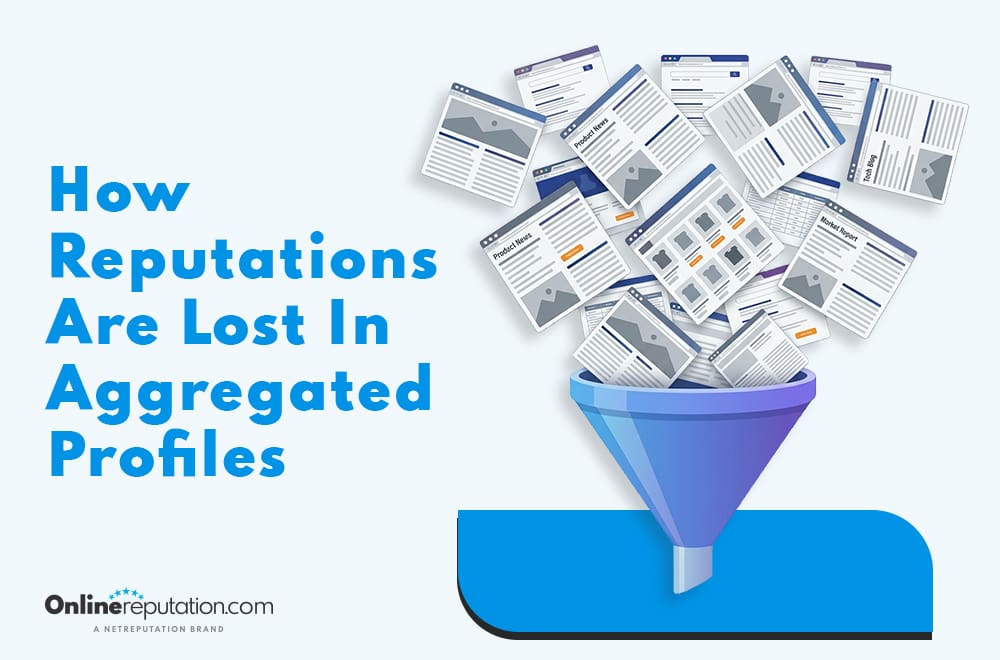
A single event rarely destroys reputations. Instead, they are lost through aggregation.
For example, one comment becomes data. One review becomes a signal. One article becomes a reference.
Over time, these details are grouped, averaged, ranked, and reused by systems designed to simplify complex information. As a result, an aggregated profile emerges that no longer reflects intent or context. Instead, it reflects accumulation.
Once this profile hardens, reversing its impact becomes difficult.
What Aggregated Profiles Are
Aggregated profiles are unified views of a person or company created by combining data from many individual profiles.
They pull from:
- Reviews and public feedback
- News and articles
- Social activity
- Public records
- Third-party databases
- Internal company systems
Each source contributes details. Together, they create a comprehensive profile that appears complete, even when it is not.
These profiles are helpful for analysis because they simplify information, support reporting, and help models identify trends. However, they also remove nuance, as aggregation favors volume over relevance.
Why Aggregation Exists (And Why AI Relies on It)
Aggregation is not malicious; rather, it is practical.
AI systems, analytics platforms, and search models rely on aggregated data to:
- Reduce complexity
- Identify patterns
- Generate insights
- Answer questions quickly
Aggregated datasets are often used to train AI models and power AI search results. They enable systems to summarize behavior, predict outcomes, and surface conclusions quickly.
Nevertheless, the reliability of those insights depends entirely on the quality and balance of the original data.
When negative or incomplete information dominates an aggregated set, the output inevitably reflects that imbalance.
Free Consultation
Ready to Take Control of Your Online Reputation?
Our team can help you remove, suppress, or respond to content like this. Talk to us today for a free, no-obligation consultation.
How Aggregation Changes Meaning
A single data point rarely defines a reputation; aggregation changes the scale.
For example:
- One negative review is an isolated instance
- Ten similar reviews form a recognizable pattern
- That pattern becomes a value assigned to the profile
Analytics systems do not ask why the data exists. Instead, they record what exists. Consequently, repetition becomes relevance, and frequency becomes weight.
As models update, the aggregated profile changes automatically, even when the underlying details are outdated or inaccurate.
The Three-Step Pattern of Reputation Loss
Reputation loss in aggregated profiles usually follows a similar pattern.
1. A Trigger Appears
A single activity draws attention. It could be a comment, a complaint, a misunderstanding, or a mistake.
On its own, it may seem minor.
2. Aggregation Accelerates It
The trigger is copied, summarized, and grouped with related data.
Systems combine:
- Similar language
- Shared keywords
- Common locations or account details
- Linked profiles
Thus, the profile becomes increasingly negative through combinations, not through intent.
3. The Result Becomes the Default
Once aggregated, the profile is treated as defined.
Readers see:
- A summary instead of details
- A score instead of a timeline
- A result instead of a process
At this point, the loss of reputation feels sudden. However, in reality, it was incremental.
Why Aggregated Profiles Are Hard to Correct
Aggregated profiles update quickly because they rely on automation, speed, and scale.
In contrast, corrections move slowly.
A single updated page rarely outweighs dozens of existing references. Systems value number and repetition more than recency. AI search models and analytics engines tend to reinforce what appears most often, not what changed yesterday.
This imbalance is why reputations often feel “locked in.”
Free Consultation
Talk to a Reputation Management Expert
Get a personalized plan to protect and repair your online reputation.
Common Ways Reputations Are Lost
Cross-Profile Dependency
Many profiles share identifiers such as names, emails, locations, or company properties. Consequently, a problem in one place flows into others.
Outdated Data
Old details remain accessible because aggregation systems do not always separate current information from historical records.
Misclassification
Content is grouped incorrectly. For example, a person is assigned to the wrong group, or a company is linked to unrelated activity. Once assigned, these labels persist.
Loss of Context
Aggregated profiles summarize for speed; therefore, they favor quick answers over careful explanation.
Why This Affects Both People and Companies
For individuals, aggregated profiles influence:
- Hiring decisions
- Professional trust
- Visibility
For companies, they affect:
- Customer confidence
- Partner decisions
- Brand credibility
In both cases, the aggregated profile is often read before direct contact happens. As a result, opinions form early, sometimes within seconds of clicking a result.
What Makes AI Search Amplify the Risk
AI search systems depend heavily on aggregation.
They pull from:
- Existing profiles
- Summarized datasets
- Pattern-based models
AI does not evaluate intent; it evaluates presence.
If a detail appears often enough across sources, it becomes part of the answer. If a negative pattern exists in the data, AI-generated summaries will reflect it.
This is not biased. It is math.
Free Consultation
Don't Let This Follow You Online
Every situation is different. Let's build a plan that fits yours — free consultation, no pressure.
Early Warning Signs to Watch For
Reputation loss rarely starts with a crisis.
Instead, it begins with:
- A shift in summaries
- Repeated phrasing across profiles
- The exact detail appears in multiple places
- Old issues resurfacing in new contexts
These are signs that aggregation is changing how your profile is being interpreted.
What You Can Do Before Damage Sets In
You cannot stop aggregation; however, you can influence what feeds it.
Start by:
- Identifying where your data exists
- Reviewing the most visible aggregated profiles
- Updating primary sources regularly
- Reducing contradictions across profiles
Consistency matters more than volume. Clear, current information limits the chance that outdated or irrelevant details dominate the aggregated view.
The Most Important Thing to Understand
Aggregated profiles do not judge intent; instead, they reflect presence.
If something exists online long enough, it becomes part of the record.
If it appears often enough, it becomes the story.
Reputations are not lost in one day; they are lost through accumulation.
Once aggregation defines you, changing perception takes far more effort than preventing damage in the first place.
Free Consultation
Ready to Take Control of Your Online Reputation?
Our team can help you remove, suppress, or respond to content like this. Talk to us today for a free, no-obligation consultation.
Final Thought
To protect a reputation, you must look beyond individual profiles and understand how they aggregate.
The question is no longer: “Is this true?” Instead, it is: “How often does this appear, and where?”
That is how reputations are lost in aggregated profiles.
Free Consultation
Don't Let This Follow You Online
Every situation is different. Let's build a plan that fits yours — free consultation, no pressure.
You might also like
5 Online Reputation Threats You Can’t Ignore in 2026
This article discusses franchise review management, which is the process of monitoring, analyzing, and responding to customer feedback across all …
