
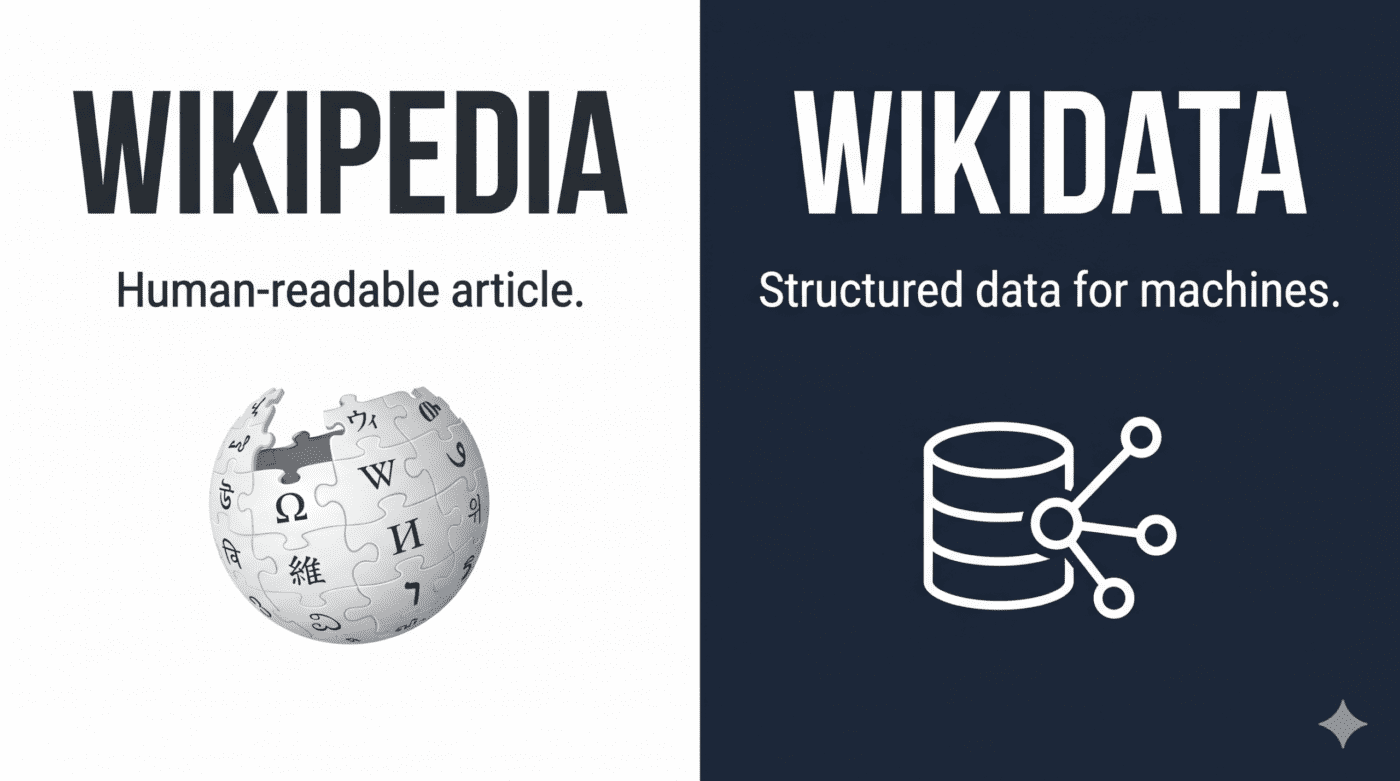
If you’ve spent any time researching your brand’s online presence, you’ve probably heard that a Wikipedia page is the gold standard of digital credibility. But somewhere along the way, you may have also come across “Wikidata” and wondered whether it’s the same thing as Wikipedia, a subset of Wikipedia, or something you need to handle separately. The answer matters more than most brands realize. The Wikipedia page vs. Wikidata question is not about choosing one over the other. It’s about understanding what each one does, which one you actually qualify for right now, and how both shape what AI systems say about your brand.
What Is a Wikipedia Page?
Wikipedia is a free, human-readable encyclopedia. Volunteer editors write articles in prose and hold them to strict standards around neutrality, sourcing, and factual accuracy.
For brands, a Wikipedia page does several things at once. It appears near the top of Google search results for branded queries and feeds the Google Knowledge Panel, the information box that shows up on the right side of desktop results. It also signals legitimacy to journalists, investors, and customers who look you up. Perhaps most importantly, it serves as a primary training source for large language models. What Wikipedia says about a brand directly shapes what ChatGPT and Gemini repeat about it.
The catch, however, is the notability requirement. Wikipedia is not open to every brand that wants a page. To survive editorial review, a brand needs substantial independent coverage in reliable secondary sources. That means in-depth articles from credible publications, written by journalists rather than press releases, sponsored content, or brand-authored pieces. Most editors expect at least three to five qualifying sources before a page is defensible. Without them, a new page is quickly deleted.
What Is a Wikidata Entry?
Wikidata is a structured, machine-readable database. Instead of articles, it contains statements. Each entry consists of labeled properties paired with values: founding date, headquarters location, industry, official website, key personnel. Search engines and AI systems can query these statements directly.
Every Wikidata item also receives a unique identifier called a QID. That QID helps databases, search engines, and AI platforms recognize a brand as a specific, distinct entity regardless of language or platform. As a result, it eliminates ambiguity when multiple organizations share similar names.
Wikidata and Wikipedia share the same parent organization, the Wikimedia Foundation. Even so, the two projects serve completely different audiences. Wikipedia is written for readers. Wikidata is built for machines.
For brands, the most important practical difference is this: Wikidata has no notability threshold. Any real, verifiable entity with a public presence can create an entry. The requirement is accuracy and sourcing, not fame or media coverage.
Free Consultation
Don't Let This Follow You Online
Every situation is different. Let's build a plan that fits yours — free consultation, no pressure.
The Key Difference Between Wikipedia and Wikidata
Here is a direct comparison to make this concrete:
| Wikipedia | Wikidata | |
|---|---|---|
| Format | Prose articles for human readers | Structured statements for machines |
| Who can get one | Brands with substantial independent media coverage | Any real, verifiable organization |
| Notability required | Yes, strict threshold | No |
| What it produces | Narrative credibility, Knowledge Panel, search visibility | Structured facts, QID, Knowledge Graph recognition |
| How AI uses it | Training data for narrative brand context | Real-time entity fact retrieval |
| Created by | Volunteer editors (you can propose, not write your own) | Anyone with an account (with sourcing) |
Ultimately, the key difference between Wikipedia and Wikidata comes down to their audiences and purposes. Wikipedia tells a story to humans and to the AI systems trained on human-readable text. Wikidata, by contrast, delivers structured facts to systems that need to resolve entity data quickly and accurately.
How AI Platforms Use Wikipedia vs. Wikidata
This distinction becomes especially important when you look at how different AI tools actually work.
Large language models like ChatGPT and Gemini train heavily on Wikipedia. The prose on your Wikipedia page becomes part of the narrative these systems draw on when someone asks a question about your brand. If the article is sparse, outdated, or missing entirely, the model fills gaps using whatever else it encountered during training, which often means lower-quality sources or nothing reliable at all.
Wikidata works differently. Retrieval-based tools like Perplexity and ChatGPT, when browsing is enabled, query Wikidata-linked databases in real time to pull specific facts. A complete Wikidata entry gives these systems structured, sourced answers: when the company was founded, where it operates, what industry it belongs to, who leads it. Without that entry, AI systems infer facts from unstructured web content. Inference introduces error.
For brands without either, the risk is real. AI-generated descriptions of your organization may be wrong, inconsistent across platforms, or conflated with another entity that shares your name. That kind of inaccuracy tends to compound over time and affects how AI answers brand queries in tools people use every day.
Which One Does Your Brand Actually Need?
Start with an honest assessment of where you stand on the notability question.
If your brand has earned coverage in three to five substantial, independent articles from credible publications, you may already qualify for a Wikipedia page. In that case, the Wikipedia page is the stronger signal of the two and should be your first priority. Even so, do not create it yourself. Building a Wikipedia page for your organization violates the platform’s conflict-of-interest guidelines. Instead, work through disclosed editorial channels or engage a Wikipedia consulting firm that operates within Wikimedia Foundation compliance standards.
If your brand does not yet have that level of independent coverage, do not attempt a Wikipedia page you cannot defend. A page nominated for deletion is worse for your brand than no page at all.
What you can do right now is create a Wikidata entry. No third-party editorial approval is required. You need a free account, a verifiable entity, and sourced statements. At minimum, include a clear label and neutral description, the “instance of organization” property, founding date, headquarters location, official website, industry classification, and key personnel linked to their own Wikidata items where possible. Adding external identifiers for LinkedIn and Crunchbase further strengthens the entry. Once your entry has a QID, add that URL to the sameAs field in your Organization schema markup on your website. This connects your Wikidata entry to your site in Google’s Knowledge Graph and is one of the more reliable triggers for generating a Knowledge Panel.
NetReputation’s entity optimization work follows this same sequence: verify or build the Wikidata entry first, then pursue the Wikipedia page once the notability threshold is reachable through earned media.
Free Consultation
Ready to Take Control of Your Online Reputation?
Our team can help you remove, suppress, or respond to content like this. Talk to us today for a free, no-obligation consultation.
Why Having Both Is the Strongest Position
A Wikipedia page and a Wikidata entry serve different layers of the same goal. Wikipedia builds human trust and supplies the narrative that LLMs draw from. Wikidata, on the other hand, supplies machine-readable facts that AI retrieval tools pull in real time. Together, they give AI systems more to work with at every layer of the process.
When a Wikipedia page links to a Wikidata item through the sitelinks section, Google can cross-reference structured facts with the editorial narrative. That alignment strengthens Knowledge Panel accuracy and reduces the risk of AI-generated errors. It also keeps your entity consistent across different language editions of Wikipedia and across platforms that rely on Wikidata as a shared authority source.
For most brands, building toward both takes time. Earning the media coverage that Wikipedia requires can take months of deliberate PR work. Even so, the Wikidata entry is available today, and creating it now means AI systems have accurate, structured facts to work from while you build toward the larger goal.
Start with Wikidata. Build toward Wikipedia. Once both exist, monitor them regularly, because both platforms allow public edits and both require periodic review to stay accurate.
Free Consultation
Talk to a Reputation Management Expert
Get a personalized plan to protect and repair your online reputation.
You might also like
What Are the Best Review Websites for Local Businesses?
A single scandal closed a beloved small-town diner. The same type of incident, at a large chain in Chicago, barely …
